
Technique · The Spring Journal
What is Lomi Lomi massage? the Hawaiian long stroke, explained
Most massage works one region at a time. Lomi Lomi doesn't — it moves in long, continuous passes that cross the body from shoulder to hip in a single stroke. Here is what that actually feels like, and who tends to love it.
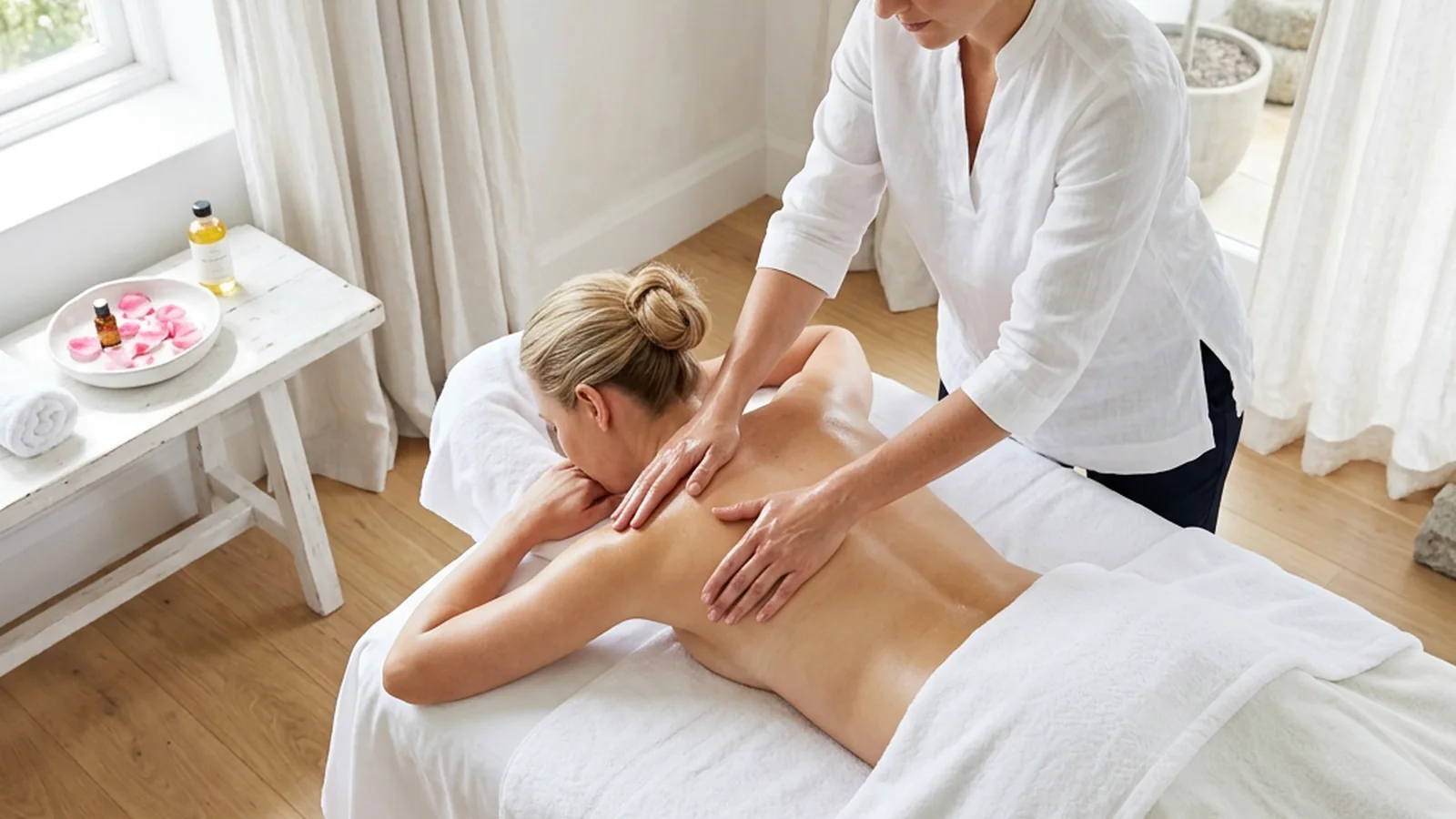
Lomi Lomi massage is a Hawaiian bodywork style built on long, continuous forearm strokes that cross the body in a single pass — shoulder to hip, hip to heel — instead of working one muscle group at a time. At Spring Massage on North Coit Road it runs 60 minutes for $80, 90 minutes for $110 or 120 minutes for $140, seven days a week until 9:30 PM. That is the short answer. The longer one is more interesting, and it carries a caveat most spa pages quietly leave out.
Take the caveat first, because it changes how you should read everything below. None of the medical sources this site is permitted to cite has published anything at all about this style. Not the National Center for Complementary and Integrative Health, not Mayo Clinic, not the American Massage Therapy Association. No trial, no review, no clinical summary. So this page describes what the technique is and what an hour of it feels like. It makes no claim that the style treats a condition, because nobody has shown that it does.
What is Lomi Lomi massage? The one-paragraph answer
It is massage performed largely with the forearms rather than the fingertips, in rhythmic strokes that keep moving. A conventional back massage tends to be a sequence of stops: the therapist works the right shoulder, then the left, then the mid-back, then the hips. The Hawaiian approach does the opposite. One stroke may start at the top of the shoulder blade and finish somewhere near the opposite hip, and the next begins before the last has quite ended. Nothing is worked in isolation and very little is worked twice in the same way. Over 60 minutes that produces a distinctly different sensation from either the classic Swedish hour or the slow, static pressure of firm-pressure deep tissue work.
| Lomi Lomi (Hawaiian) | Swedish / relaxation | Deep tissue | |
|---|---|---|---|
| Main tool | Forearm, elbow-to-wrist | Hands, thumbs, palms | Forearm, elbow, thumbs |
| Stroke length | Crosses two or more regions | One region at a time | Short and stationary |
| Pace | Continuous, rhythmic | Flowing, with pauses | Slow, often held |
| Pressure | Medium and spread out | Light to medium | Firm and concentrated |
| Best for | People who dislike being worked on in pieces | Stress and general tension | One ache you can point to |
| 60 minutes here | $80 | $65 | $70 |
| Longest option | 120 min · $140 | 120 min · $130 | 120 min · $140 |
- Lomi Lomi (Hawaiian)
- Forearm, elbow-to-wrist
- Swedish / relaxation
- Hands, thumbs, palms
- Deep tissue
- Forearm, elbow, thumbs
- Lomi Lomi (Hawaiian)
- Crosses two or more regions
- Swedish / relaxation
- One region at a time
- Deep tissue
- Short and stationary
- Lomi Lomi (Hawaiian)
- Continuous, rhythmic
- Swedish / relaxation
- Flowing, with pauses
- Deep tissue
- Slow, often held
- Lomi Lomi (Hawaiian)
- Medium and spread out
- Swedish / relaxation
- Light to medium
- Deep tissue
- Firm and concentrated
- Lomi Lomi (Hawaiian)
- People who dislike being worked on in pieces
- Swedish / relaxation
- Stress and general tension
- Deep tissue
- One ache you can point to
- Lomi Lomi (Hawaiian)
- $80
- Swedish / relaxation
- $65
- Deep tissue
- $70
- Lomi Lomi (Hawaiian)
- 120 min · $140
- Swedish / relaxation
- 120 min · $130
- Deep tissue
- 120 min · $140
Where the name comes from, and what we will not claim about it
The word itself
Lomi is the Hawaiian word for kneading, rubbing or pressing, and doubling a word is a common Hawaiian intensifier — so the name translates roughly as "to knead, again and again". That much is language, and it describes the technique accurately: repetition is the whole point of the style.
The part that is tradition, not record
Beyond the word, the honest position is that we are not the right source for the history. Spa websites routinely print confident paragraphs about ancient Hawaiian healing lineages, and none of them cite anything you could check. We are a massage studio in McKinney, Texas, open since August 2024. We can tell you exactly what happens on our table for 60, 90 or 120 minutes. We cannot verify a cultural history, so we do not narrate one.
“If a spa page tells you a technique is thousands of years old and also clinically proven, check which of those two claims it is actually able to support. Usually neither.”
What a session actually feels like
The practical shape of the appointment is the same as any other booking here. What changes is the middle 40 minutes. Below is the sequence of a 90-minute Lomi Lomi session, which at $110 is the length most guests settle on after trying the hour once.
-
Arrival and intake
Two or three minutes at reception. You say where you are sore, what you want left alone, and anything medical the therapist needs to know. Surface parking sits directly outside the door at 1400 N Coit Rd #102, so this is not a session you arrive at flustered. -
Undressing and draping
You undress to your own comfort level in the room and lie under a sheet. Only the area being worked is uncovered at any moment. -
The opening passes
Warm oil, then five to ten minutes of broad, light forearm work down the length of the back. This is calibration: the therapist is learning where you hold, and you are learning what the pressure feels like. Say now if you want more or less. -
The long work
The core of the session — roughly 35 to 45 minutes in the 90-minute booking. Strokes lengthen and connect: shoulder into opposite hip, hip into hamstring, hamstring into calf. Your therapist may work from the side of the table or from the head, moving around you rather than standing in one place. -
Turning over
Face up for the front of the shoulders, the arms, sometimes the neck and scalp. Shorter than the back work — usually 15 to 20 minutes. -
The close
A few slow passes, then a minute of quiet before you sit up. Take it. Standing up too quickly after an hour of continuous rhythmic work is the most common reason people feel briefly light-headed.
Oil, draping and how much you undress
Because the strokes are long and oiled, they run more smoothly with fewer waistbands in the path — but the rule is the one the American Massage Therapy Association sets out for any professional session: you undress to your comfort level, you are draped throughout, and you are never asked to justify the choice. AMTA also notes that tips are appreciated but not required. If this is your first professional appointment of any kind, our guide to what actually happens at a first massage walks through the whole hour, door to door.
Lomi Lomi vs Swedish: the practical difference
They are close relatives, and a therapist who is good at one is usually good at the other. Four differences matter when you are choosing between the $65 hour and the $80 one:
- The tool. Hands and thumbs for Swedish; forearms for most of the Hawaiian hour, which spreads pressure over a wider surface and makes it feel firmer without being sharper.
- The geometry. Swedish treats the back, then the legs. The long-stroke style treats the back into the legs, so the transitions disappear.
- The rhythm. Swedish has natural pauses. This work is close to continuous, which is why some people find it easier to switch off during.
- The finish. Guests often describe the Swedish hour as calming and the Hawaiian one as loosening — the same broad effect, arrived at differently.
If your problem is a single locked-up spot rather than a general heaviness, neither is the right booking; read how Swedish and deep tissue differ before you choose, and then book the firmer one.
What the evidence supports, and what it does not
This is where most articles on the subject start inventing. Here is the accurate version. NCCIH summarises the evidence for massage therapy in general as limited, with relief that is often short-term, and it lists the circumstances in which massage should be avoided or modified. It does not mention this style, because no body of research on it exists to summarise. Mayo Clinic's massage overview is similar in scope: it describes what massage is used for, states plainly that it should not be painful, and lists the conditions to check with a doctor about first.
So the honest framing is this. Any general benefit that applies to massage as a category — a temporary drop in muscle tension, an hour of genuine rest — plausibly applies here too, at the same modest strength. Nothing extra has been demonstrated for the long stroke specifically. Anyone selling it as detoxifying, energy-clearing or lymph-flushing is well past what can be supported.
Lomi Lomi flushes toxins and realigns your energy.
No approved clinical source makes either claim, and NCCIH does not describe massage in those terms at all. What the technique reliably does is cover a lot of tissue slowly and warmly for an hour. That is a real thing, and it is enough.
Who tends to book it, and who probably should not
- People who found Swedish pleasant but slight. The forearm work reads as firmer at the same nominal pressure.
- People who dislike being worked on in pieces. If the stop-start rhythm of a conventional massage keeps pulling you back to alertness, the continuous version suits you better.
- Anyone whose whole back and legs feel heavy rather than one spot hurting — after a long drive, a long shift, a long week.
- Guests booking a 90 or 120-minute escape where length is the point. At $110 for 90 minutes, this is the middle of our menu, not the top.
Two groups should book something other than Lomi Lomi:
- If you can point at the problem with one finger, book 60 minutes of deep tissue at $70 instead. Broad strokes will not resolve a single stubborn knot.
- If oil in your hair is a problem, say so at intake — much of the work is oiled and covers the shoulders, and the neck and scalp portion is easy to leave out.
Booking Lomi Lomi massage in McKinney
Spring Massage is at 1400 N Coit Rd #102, in the Crescent Parc centre where Coit Road meets Prestwick Hollow Drive, one block south of US-380. That corner sits on the McKinney–Prosper–Frisco seam: Prosper is about 10 minutes north, Frisco about 15 minutes south-west, Celina about 18, Fairview about 22, and Allen, Melissa and Little Elm all about 25. Stonebridge Ranch and the Eldorado Parkway corridor are roughly 10 to 12 minutes east. We are open every day from 10 AM to 9:30 PM, and same-day appointments are often available — the booking page shows today's real openings rather than a request form. Card payments carry a $2 transaction fee.
Massage therapy in Texas is a licensed profession: the Texas Department of Licensing and Regulation issues the Massage Therapist licence under Chapter 455 of the Texas Occupations Code and also licenses massage establishments. Our own booking page describes our therapists as licensed massage therapists, and TDLR's register is public, so any credential in Texas can be checked in about a minute. If you are still weighing up frequency rather than technique, our note on how often to book a massage is the honest version, and the full McKinney price list shows every rate on one page.
Lomi Lomi Massage
The Hawaiian style: long, continuous, wave-like forearm strokes that travel the whole body rather than working spot by spot.
- 60 min · 60 min $80
- 90 min · 90 min $110
- 120 min · 120 min $140
Prices in USD, for one guest. Card payments carry a $2 transaction fee. Open every day, 10 AM to 9:30 PM.