
Practical guide · The Spring Journal
How often should you get a massage? there is no medical answer, and that's the answer
Every studio has a recommended frequency, and every recommended frequency happens to suit the studio. So here is the version with the commercial interest labelled: what the evidence supports, what is convention, and how to choose for yourself.
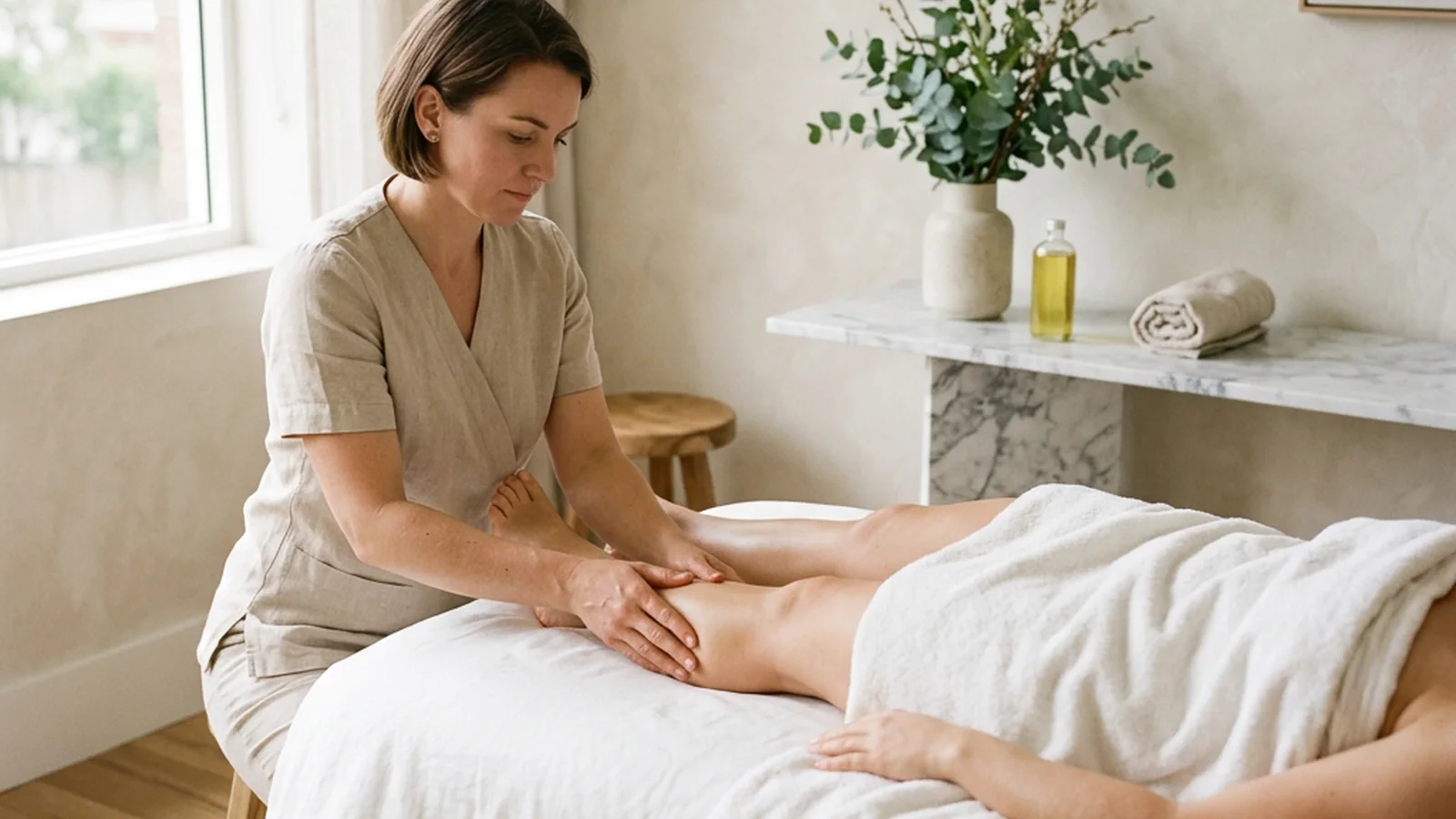
No clinical guideline tells a healthy adult how often a massage should be booked. Not NCCIH, not Mayo Clinic, not any professional body. That absence is the most useful fact on this page, because everything else you have read on the subject was built on top of it. What actually exists is convention, a thin evidence base about dose, and your own budget. At Spring Massage an hour of relaxation work is $65, so the real question was never medical: it is what a $65 hour is worth to you, and how many days the effect lasts.
Massage frequency means the interval you keep between sessions — weekly, fortnightly, monthly, or only when something hurts. Every studio publishes a house recommendation, and the house recommendation is always more often than never. Ours is below with the commercial interest labelled, because a recommendation you cannot audit is just an invoice with adjectives attached.
How often a massage “should” happen: the short answer
Common practice across the industry is one session every two to four weeks for general wellbeing, and weekly for a short run when one area is genuinely bothering you. That is convention. It is not medicine, it is not a guideline, and it has never been tested against the alternatives. We sell massage — a 30-minute session is $50, an hour is $65, 90 minutes is $100 and two hours is $130 — which is precisely why that sentence needs the label rather than a confident tone.
What the research actually supports
Dose looks more important than technique
The NCCIH clinician digest reviews the massage trial evidence condition by condition and grades most of it low- to moderate-quality. Read across those reviews and one pattern is more consistent than any other: the studies that report a benefit for neck or back pain tend to use sessions of around 60 minutes, repeated over a course of several weeks, rather than one long session. That is the closest thing to a frequency signal in the approved literature, and it is a description of how the trials were run — not a dose the researchers recommend for you.
"Short-term" is the phrase that keeps reappearing
The NCCIH overview of massage therapy summarises the evidence as limited and the relief as often short-term. Follow that honestly and the logic runs like this: if the effect fades, then regularity is how you keep it, and that is a reasonable argument for coming back. It is not evidence that sessions stack into a permanent change. Nobody has demonstrated that. Anyone selling a package on the promise of cumulative structural improvement is selling ahead of the research.
What no source can tell you
There is no published comparison of weekly against fortnightly against monthly booking in healthy adults, with wellbeing measured at the end. Until someone runs that trial, how often a massage ought to be repeated has no published answer, and an "optimal interval" cannot be reported by anybody, including us. What can be reported is what the session costs, how long people say the effect lasts, and how to test it on yourself — which is what the rest of this page does.
Your body needs a massage every two weeks or you lose the benefit.
Nobody has shown that. NCCIH grades most massage research low- to moderate-quality and describes relief as often short-term, and it publishes no frequency schedule for healthy adults. "Every two weeks" is studio convention that happens to suit studios.
What people actually do
The American Massage Therapy Association runs an annual consumer survey on how often Americans book massage and why they say they book it. It is genuinely useful context — and it is self-reported behaviour, not an outcome study. Popular is not the same as effective. Treat it the way you would treat any survey of what a market does: a description of habit, and a poor substitute for a recommendation.
Which leaves three honest inputs, and only three:
- How long the effect lasts on you — measurable in days, and personal.
- What the hour costs — $65 here, published, and the same rate on a Tuesday as on a Saturday.
- Whether the appointment is easy to reach — a 10-minute drive keeps a habit that a 40-minute one quietly kills.
“There is no medically correct interval. There is only the interval you will actually keep.”
Choosing a frequency by the reason you are booking
The reason on the booking form is a better guide than any general rule. A stressful quarter and a shoulder that has been locked since March are different problems and they take different rhythms. The intervals below are common practice at studios like ours; the prices are our published menu.
| Why you are booking | Interval people commonly choose | At Spring Massage |
|---|---|---|
| A stressful stretch at work | Every 2–4 weeks | 60-min relaxation · $65 |
| One area that keeps tightening | Weekly for 3–4 weeks, then stretch it out | 60-min deep tissue · $70 |
| A heavy training block | Every 1–2 weeks while it lasts | 90-min deep tissue · $110 |
| On your feet all day | Monthly | 60-min body + foot combo · $60 |
| No complaint, just want the hour | Quarterly, or on occasions | 60-min Lomi Lomi · $80 |
| Two of you, together | Anniversaries and birthdays | Couples Swedish 60 min · $120 for both |
- Interval people commonly choose
- Every 2–4 weeks
- At Spring Massage
- 60-min relaxation · $65
- Interval people commonly choose
- Weekly for 3–4 weeks, then stretch it out
- At Spring Massage
- 60-min deep tissue · $70
- Interval people commonly choose
- Every 1–2 weeks while it lasts
- At Spring Massage
- 90-min deep tissue · $110
- Interval people commonly choose
- Monthly
- At Spring Massage
- 60-min body + foot combo · $60
- Interval people commonly choose
- Quarterly, or on occasions
- At Spring Massage
- 60-min Lomi Lomi · $80
- Interval people commonly choose
- Anniversaries and birthdays
- At Spring Massage
- Couples Swedish 60 min · $120 for both
How to set your own interval, measured rather than guessed
This is the honest replacement for a recommendation: measure it. It takes about six weeks and it gives you a number that applies to you rather than to an average.
-
Book 60 minutes, and write down the date
Not 30. A half-hour session at $50 is a targeted tool, not a baseline — it is too short to tell you much about how long an effect lasts. Start with the full hour at $65, in whichever style fits: relaxation if the whole week is the problem, deep tissue if you can point at the spot. -
Count the days until you feel like you did before
Most people can name it: four days, nine days, three weeks. That number is your actual interval, and it is the only personal data in this whole subject that is worth anything. Write it on the calendar the day it happens, not from memory a month later. -
Set the gap just inside that number, then re-check
If the effect fades at day nine, a four-week interval means three weeks without it — which may be fine, or may be the reason you keep arriving in the same state. Book the next one a little before the fade, run three sessions at that spacing, then reassess. Bodies and workloads both change; the interval should too. -
Let the budget speak plainly
Once a month at $65 is about $780 a year. Every fortnight is about $1690. Neither figure is right or wrong — but seeing them written down is a better basis for deciding than a wellness slogan, and it is cheaper than a membership you stop using in March.

What each rhythm costs at Spring Massage
Our menu is short and the prices do not move with the day of the week. There is no membership, no introductory rate that changes on your second visit, and no package you have to buy to get the ordinary price. That matters to a frequency decision more than any wellness advice: you can come once a year or once a fortnight and pay the same rate per hour either way. The full list, including 120-minute sessions, sits on the McKinney price page.
Relaxation Massage
Long, gliding Swedish strokes and gentle kneading — the classic full-body reset, from a 30-minute tune-up to a two-hour escape.
- Relaxation · 30 min $50
- Relaxation · 60 min $65
- Relaxation · 90 min $100
- Relaxation · 120 min $130
Deep tissue runs $70 for the hour and $110 for 90 minutes. Card payments carry a $2 transaction fee.
When going more often is not the answer
Frequency is the wrong lever for some problems, and increasing it can quietly delay something that needs a clinician instead. A few signs that the interval is not what needs changing:
- You are still sore from the last one. Mild tenderness for a day is common; arriving tender is a sign to go lighter, not more often.
- Nothing lasts past the drive home. If a 60-minute session buys three hours, the problem is probably not the interval — look at the desk, the sleep and the load first.
- The same spot every time, for months. Worth a medical opinion before booking a twelfth session on it. Our notes on massage and lower back pain set out exactly where the evidence stops.
- You are booking to avoid dealing with the cause. An honest studio will say this out loud; massage is general wellness, not treatment.
Fitting the interval into a real week in McKinney
A schedule only survives if the appointment is easy to reach. Spring Massage is at 1400 N Coit Rd #102, McKinney, TX 75071 — suite 102 in the Crescent Parc centre, on Coit Road at Prestwick Hollow Drive, one block south of US-380 (University Drive), with surface parking directly outside the door. The studio opened in August 2024, and the hours are the same every day of the week: 10 AM to 9:30 PM. Because it closes at 9:30 rather than 6, an appointment after work is an ordinary option rather than a favour, which is the single biggest reason a monthly habit survives past February — how often a massage fits your month is settled by the calendar at least as much as by the body.
That corner sits on the McKinney–Prosper–Frisco seam, so the drive is short from more places than the address suggests: about 10 minutes from Prosper, about 15 from Frisco, about 18 from Celina, and roughly 10 to 12 minutes from Stonebridge Ranch and the Eldorado Parkway corridor. Booking runs through the studio's Setmore calendar, which shows live availability; same-day appointments are often open, and the calendar is the only honest way to see tonight. If you are weighing up an evening slot, our page on same-day and late massage appointments covers how evening booking works here.
On credentials: massage therapy in Texas is regulated by the Texas Department of Licensing and Regulation, which issues the Massage Therapist licence under Chapter 455 of the Texas Occupations Code and licenses massage establishments as well. The studio's own booking page describes its therapists as licensed massage therapists, and the state register is public — so that is a claim you can check rather than take on trust. If this would be your first appointment anywhere, our guide to what actually happens at a first massage covers the awkward questions before you pick an interval at all.