Evidence review · The Spring Journal
Massage for stress and anxiety: what an hour can and can't do
Nearly every spa promises stress relief. Some of that promise is supported, some of it is marketing that borrowed the vocabulary of research. This is where the line sits.
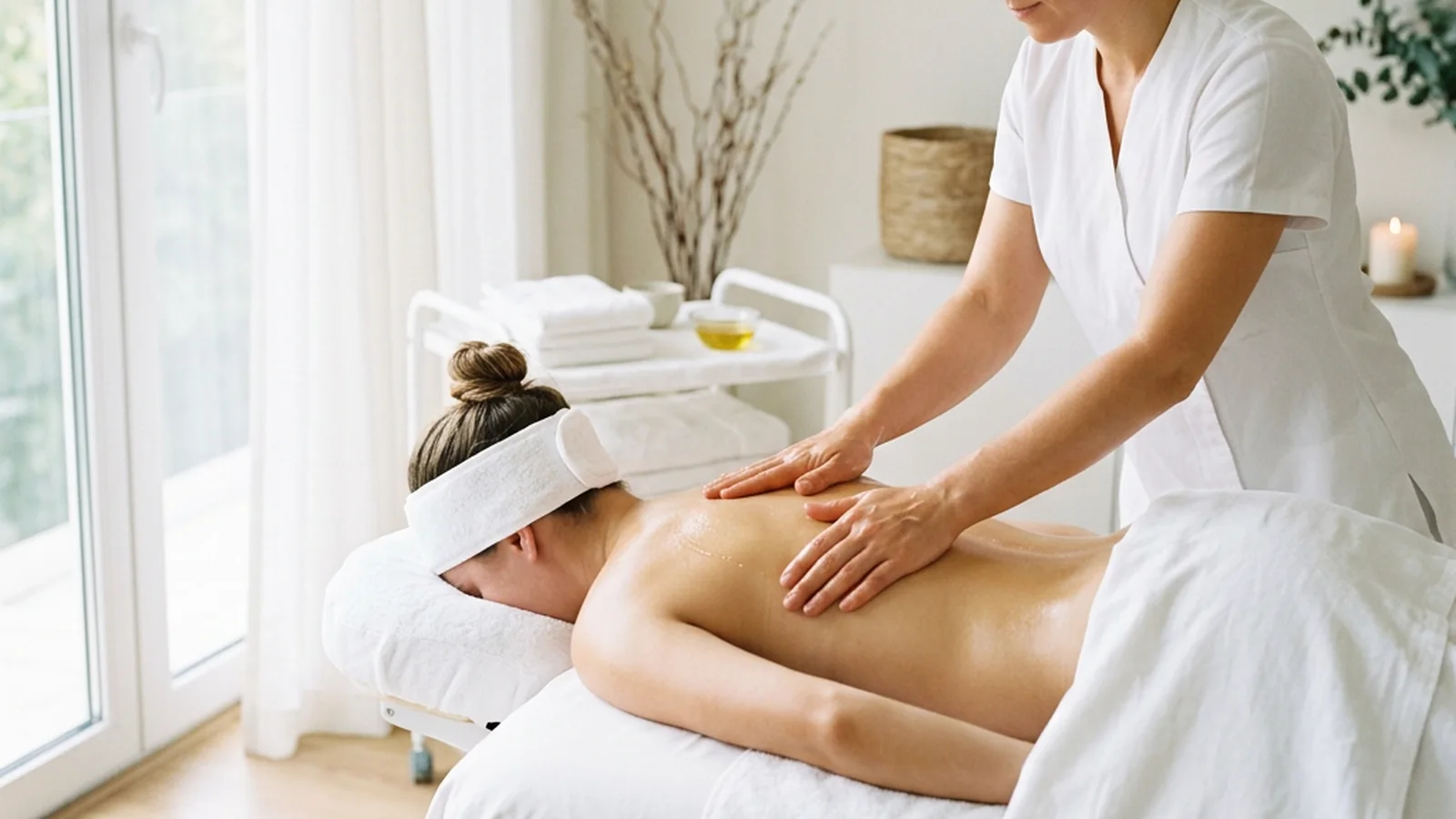
Massage for stress and anxiety is an ordinary massage session used for a particular purpose: not to fix a shoulder, but to bring your physical arousal down for a while. In practice that means 60 minutes of long Swedish strokes — $65 at Spring Massage, 1400 N Coit Rd #102 in McKinney — in a room with the lights low and nothing asked of you. Whether it feels good is not the question. What it changes once you are off the table is.
The honest answer has two halves and most articles publish only the first. Mayo Clinic Health System describes possible changes in the body's stress chemistry. NCCIH, reviewing the same field, grades most of the trial evidence low- to moderate-quality and calls the relief short-term. Both are true at once, and a page that gives you one without the other is selling something.
The short version, before the caveats
An hour on the table usually produces the part you can feel: slower breathing, a body that has stopped bracing, and a stretch of hours afterwards in which the week weighs less. What it does not produce is a treatment for an anxiety disorder, or anything that should replace a conversation with a doctor. Here is what gets claimed, next to what actually stands behind it.
| The claim | Who actually says it | How solid it is |
|---|---|---|
| Massage lowers cortisol, raises serotonin and dopamine | Mayo Clinic Health System, in a clinic explainer | One institution's summary — credible, not a systematic review |
| Massage slows breathing and heart rate | Mayo Clinic, listing massage among relaxation techniques | What such techniques may do — not a guaranteed result |
| The calm lasts all week | Nobody with a citation | Unsupported. NCCIH's word for the relief is short-term |
| Massage treats anxiety or depression | Nobody credible | No approved source supports it; NCCIH says don't replace conventional care |
| 60 minutes ($65) beats 30 ($50) for stress | Studio convention, ours included | Plausible on dose — trials that found effects mostly used about 60 minutes |
- Who actually says it
- Mayo Clinic Health System, in a clinic explainer
- How solid it is
- One institution's summary — credible, not a systematic review
- Who actually says it
- Mayo Clinic, listing massage among relaxation techniques
- How solid it is
- What such techniques may do — not a guaranteed result
- Who actually says it
- Nobody with a citation
- How solid it is
- Unsupported. NCCIH's word for the relief is short-term
- Who actually says it
- Nobody credible
- How solid it is
- No approved source supports it; NCCIH says don't replace conventional care
- Who actually says it
- Studio convention, ours included
- How solid it is
- Plausible on dose — trials that found effects mostly used about 60 minutes
What Mayo Clinic Health System actually says
The cortisol sentence, quoted with its name attached
Mayo Clinic Health System writes that massage therapy may decrease cortisol — the hormone released under stress — and may increase serotonin and dopamine. That single passage is the source of nearly every "massage lowers your stress hormones" line online, usually reprinted without the attribution and without the word may.
Why the attribution changes its weight
The piece is a health-system article written for patients, not a review of trials. That does not make it wrong — Mayo is about as credible as institutions get. It makes it one institution's summary rather than a settled finding, which is why we name it every time instead of laundering it into "studies show".
“A named clinic saying massage may lower cortisol is worth quoting. A spa saying massage lowers cortisol has quietly deleted the only honest word in the sentence.”
What NCCIH's grading adds
NCCIH's clinician digest works through the evidence condition by condition and grades most of it low- to moderate-quality, with benefits that are usually short-term. Applied to massage for stress and anxiety: the direction of the effect is plausible, its size and duration are not established. Small studies, short follow-up, and the unavoidable problem that nobody can be given a convincing placebo massage.
Mayo Clinic comes at it from the other side, grouping massage with the relaxation techniques that may slow breathing and heart rate and reduce muscle tension. Read together the two say something modest and useful: a relaxation practice with real physiological effects, in the same family as breathing exercises, priced at $65 an hour rather than free.
A massage releases the stress stored in your muscles.
Nothing is stored and nothing is released. Muscle under sustained stress holds more resting tension, and warmth plus pressure plus an hour of being asked to do nothing reduces it. That is the only mechanism any approved source supports.
Why the word "short-term" keeps appearing
Because the stressor is still there when you leave. A 60-minute session is about 0.6% of your week; the other 167 hours hold the same job, the same US-380 commute and the same phone. No hour of bodywork outcompetes that. What it can do is interrupt the pattern — give the nervous system a recent example of what "not braced" feels like, which is harder to recall than people expect after a long stretch of stress.
What an hour of massage for stress and anxiety looks like
There is no "anxiety protocol" on our menu, and we would not trust a studio that advertised one. What changes is emphasis: broader strokes, slower pace, more time on the places a braced posture collects. The honest shape of a 60-minute booking looks like this.
-
Minutes 0-5 — the short conversation
You say what kind of week it has been and whether anything hurts. Mention pregnancy, blood thinners, recent surgery or a skin condition now, not mid-session. -
Minutes 5-20 — stopping
Long, warm, repetitive strokes down the back and legs. It feels like nothing is happening. This is the stretch a 30-minute booking loses, and the reason $50 for half an hour is a top-up rather than a reset. -
Minutes 20-50 — the actual work
Neck, shoulders, upper back, scalp, hands. Pressure stays conversational: firm and painful are not the same thing, and Mayo Clinic states plainly that a massage should not be painful. -
Minutes 50-60 — coming back
Broad closing strokes, then a few minutes sitting up before you drive. Avoid booking anything demanding for the next hour; the effect fades fast if you walk straight back into what caused it.
Which session to book when stress is the reason
- Default choice: the Relaxation Massage — 60 minutes at $65, 90 at $100, 120 at $130.
- Stress plus one real ache: deep tissue at $70 the hour, with the firm work kept to that one region.
- Cannot switch your head off: Lomi Lomi at $80 — continuous forearm strokes with no start-stop rhythm to track.
- Racing mind, tired legs: the body-and-foot combo at $60 for 60 minutes — 40 on the body, 20 on the feet.
- Never had one: read what happens at a first massage first — the not-knowing is usually the stressful part.
Relaxation Massage
Long, gliding Swedish strokes and gentle kneading — the classic full-body reset, from a 30-minute tune-up to a two-hour escape.
- 30 min $50
- 60 min $65
- 90 min $100
- 120 min $130
Published prices, seven days a week, 10 AM to 9:30 PM. Card payments carry a $2 transaction fee. The other four categories are on the McKinney price list.
How often, and what happens in the other 167 hours
There is no clinical frequency guideline for healthy adults. When a studio says every four weeks — and we would probably say something similar if you asked — that is convention and commercial habit, not medicine. Labelled that way it is still useful: monthly is what most people sustain, and sustained is the version that matches the repeated-session shape of the research. Our frequency guide sets the numbers next to the incentive.
- Book a slot you can afford to be slow after — 6:30 PM before a quiet evening beats 12 noon between meetings.
- Sleep, daylight and walking do more for baseline stress across a month than any single hour of bodywork.
- If the same neck locks every Thursday, the cause is probably your desk. Our guide to neck and shoulder tension covers what holds between sessions.
- Two people can go at once — side-by-side couples sessions run in one private room, booked as two appointments at the same time.
Booking a massage for stress and anxiety in McKinney
Spring Massage is at 1400 N Coit Rd #102, McKinney, TX 75071 — the Crescent Parc centre where Coit Road meets Prestwick Hollow Drive, one block south of US-380. The studio opened in August 2024 and runs every day from 10 AM to 9:30 PM, which is why most stress bookings here land after 6 PM. Parking is surface parking outside the door. Same-day appointments are often available, and the online calendar shows today's real openings.
In Texas, massage therapy is regulated by the Texas Department of Licensing and Regulation, which issues the Massage Therapist licence under Chapter 455 of the Occupations Code and licenses massage establishments as well. The studio's own booking page describes its therapists as licensed massage therapists, and the TDLR register is public. Drive times are estimates rather than measured: about 10 minutes from Prosper, about 15 from Frisco, about 18 from Celina and about 25 from Allen. The full published price list is the same for all of them.