
Massage guides for McKinney, with the limits left in
Eight guides, one editorial rule: we cite five sources and no others, and we print where the evidence stops in the same sentence as the benefit. Prices quoted are the prices on our own menu, from $50 for 30 minutes.
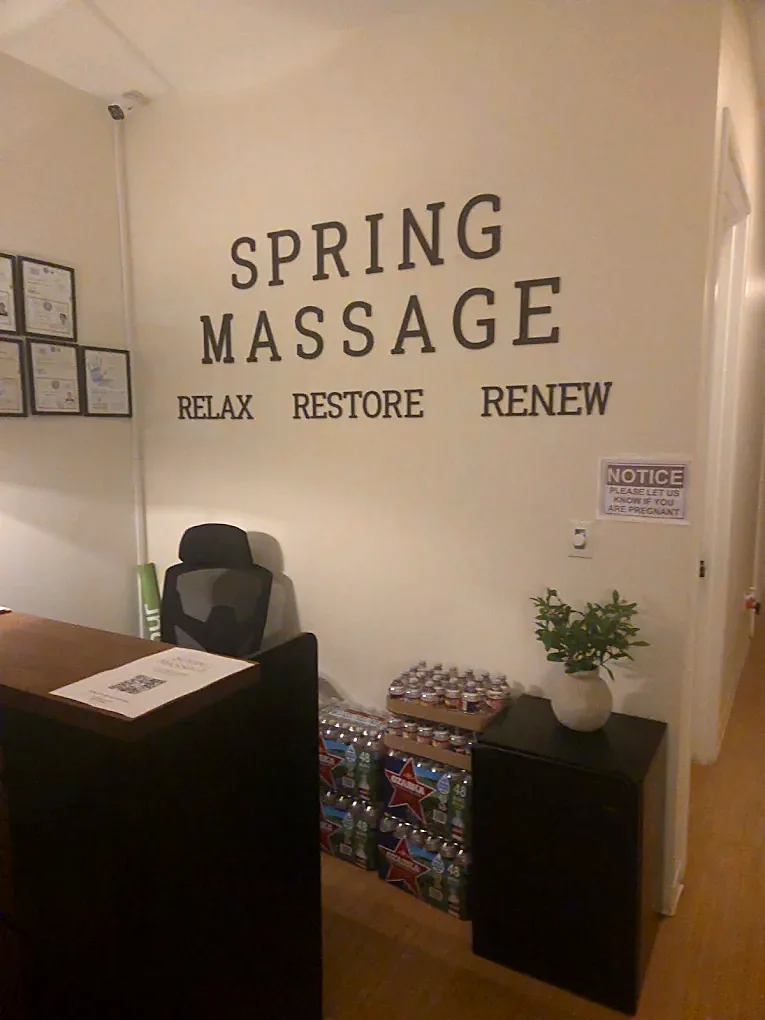
The Spring Journal is the reading half of this site — eight massage guides for McKinney readers, written at Spring Massage, 1400 N Coit Rd #102, McKinney, TX 75071, and kept deliberately apart from the pages that sell an appointment. An article here is allowed to end with "we don't know". A booking page is not the place to find that out.
One rule governs all eight. We cite five sources and no others: the National Center for Complementary and Integrative Health, Mayo Clinic, the American Massage Therapy Association, the National Institute of Neurological Disorders and Stroke, and the Texas Department of Licensing and Regulation. No blogs, no supplement sites, no studies we have not read the summary of.
That last one is the local check. Massage therapy in Texas is regulated by TDLR, which issues the Massage Therapist licence under Chapter 455 of the Texas Occupations Code and licenses massage establishments too. Our booking page describes our therapists as licensed massage therapists — and the state register is public, so that is checkable in a minute rather than a claim you take on trust.
The eight guides
Reading time runs from 7 to 9 minutes. Every card promises a limit as well as a benefit, and every article closes with its sources in full.
Swedish vs deep tissue
Pressure, pace and purpose — and why neither one is the 'better' massage.
Read the guide
What is Lomi Lomi?
The Hawaiian long stroke — what it feels like, and what nobody can honestly claim about it.
Read the guide
Massage for back pain
Short-term relief is plausible; a cure is not. What the guidelines actually say.
Read the guide
Massage for stress
The measurable effects, the honest limits, and why 'short-term' keeps appearing.
Read the guide
Neck & shoulder tension
Why it comes back — and the one thing the research is clearest about (dose, not technique).
Read the guide
How often to go
There's no clinical guideline for healthy adults — so here's how to decide honestly.
Read the guide
Your first massage
Undressing, draping, pressure, tipping — the awkward questions, answered plainly.
Read the guide
Foot reflexology
The organ-map claim doesn't hold up — here's what a foot session honestly delivers.
Read the guide
Choosing a treatment
Three guides exist to stop people booking the wrong hour. The commonest mistake is not pressure — it is paying for a technique never aimed at the problem. Start with Swedish versus deep tissue, which sets out the difference in pace and purpose.
If you can point at the ache with one finger
- Book the firmer style. A focused 30 minutes ($50) beats a scattered hour.
- If everything simply feels braced, the broad Swedish hour ($65) is the better buy.
- The Hawaiian long stroke, explained covers Lomi Lomi — flow, with forearm depth, $80 for 60 minutes.
- The honest version of the foot map explains why the organ chart has no evidence behind it, and what the foot half of the combo still does.
What the evidence says
Three guides check the claims spas make against the approved sources. They are the least flattering pages here, which is exactly why they exist. Massage for lower back pain reports NCCIH's finding that relief is short-term, and that the American College of Physicians guideline does not include massage for chronic low-back pain at all.
Where the research is thinnest
Massage for stress and anxiety attributes the cortisol and serotonin claim to Mayo Clinic Health System by name rather than presenting it as consensus. Massage for neck and shoulder tension makes the point most studios avoid: the clearest signal in the evidence concerns dose — roughly 60-minute sessions repeated over weeks — not technique. Your desk does more for the other 167 hours of the week than any single hour on a table.
Before your first visit — the awkward questions
Two guides for people who have never booked, or who book rarely and wonder whether they are overdoing it.
The questions people are too polite to ask
Your first massage, start to finish answers the three real ones — how much you undress, whether it hurts, what to tip — from AMTA's guidance on draping and the intake conversation. How often should you get a massage? gives the answer nobody selling a membership will: there is no clinical frequency guideline for healthy adults, so "every four weeks" is studio convention, not medicine.
Why we publish the limits as well as the benefits
Because a page that admits a limit is the only kind worth quoting. NCCIH describes the massage evidence as limited, with relief that is often short-term; Mayo Clinic says plainly that a session should not be painful. Write around those two sentences and everything else here becomes worthless. So the house rules are fixed:
- Attribute by name. "NCCIH reports", not "studies show".
- State the limit in the same breath. Never in a footnote, never after the button.
- No invented proof. No star ratings, no testimonials, no counts of happy clients — we publish none because none is verifiable.
- Prices come from the menu. Every figure here reads from one price list, so an article and a booking page cannot disagree.
| Source | What we cite it for | What it does not settle |
|---|---|---|
| NCCIH | Overall strength of the evidence; when massage should be avoided or modified | Whether one technique outperforms another |
| Mayo Clinic | What massage is used for, and that it should not be painful | How often a healthy adult should book |
| AMTA | How techniques are defined; what happens at an appointment | Clinical outcomes — it is a professional association |
| NINDS | Which back and nerve symptoms need a doctor first | Anything about massage specifically |
| TDLR | Texas licensing of therapists and establishments | The quality of any individual session |
- What we cite it for
- Overall strength of the evidence; when massage should be avoided or modified
- What it does not settle
- Whether one technique outperforms another
- What we cite it for
- What massage is used for, and that it should not be painful
- What it does not settle
- How often a healthy adult should book
- What we cite it for
- How techniques are defined; what happens at an appointment
- What it does not settle
- Clinical outcomes — it is a professional association
- What we cite it for
- Which back and nerve symptoms need a doctor first
- What it does not settle
- Anything about massage specifically
- What we cite it for
- Texas licensing of therapists and establishments
- What it does not settle
- The quality of any individual session
Where to book what you have just read about
The guides explain; these pages sell, and they say so. The menu runs from 30 to 120 minutes, every day from 10 AM to 9:30 PM, at one address on the west edge of McKinney — about 10 minutes from Prosper, about 15 from Frisco. Card payments carry a $2 transaction fee.
- Swedish relaxation massage in McKinney — $65 for 60 minutes, $100 for 90.
- Deep tissue massage on North Coit Road — $70 for the hour, $110 for 90 minutes.
- The body-and-foot combo — 40 minutes on the table then 20 on the feet, $60.
- Couples massage, two tables in one room — $120 for both guests.
- Lomi Lomi massage in McKinney — the Hawaiian style, from $80.
- The full price list, or same-day and late appointments if you want tonight.
Sources
- NCCIH — Massage therapy: what you need to know
- Mayo Clinic — Massage therapy
- AMTA — What to expect at a massage session
- NINDS — Back pain
- TDLR — Massage therapy licensing in Texas
General wellness information, not medical advice.
How these massage guides for McKinney are written
Who writes these massage guides for McKinney?
Which sources do you cite, and why only those?
Why do the guides keep saying the evidence is limited?
Do the guides give medical advice?
Where do the prices in the guides come from?
Read one, then book the right one
Online booking shows today's real openings — same-day appointments are often available. Or call (469) 927-8441. Open every day, 10 AM to 9:30 PM.