
Evidence review · The Spring Journal
Massage for lower back pain: what the evidence really supports
Back pain is the single most common reason people book a massage, and it is also the topic where the marketing runs furthest ahead of the research. Here is the honest version, with the caveats left in.
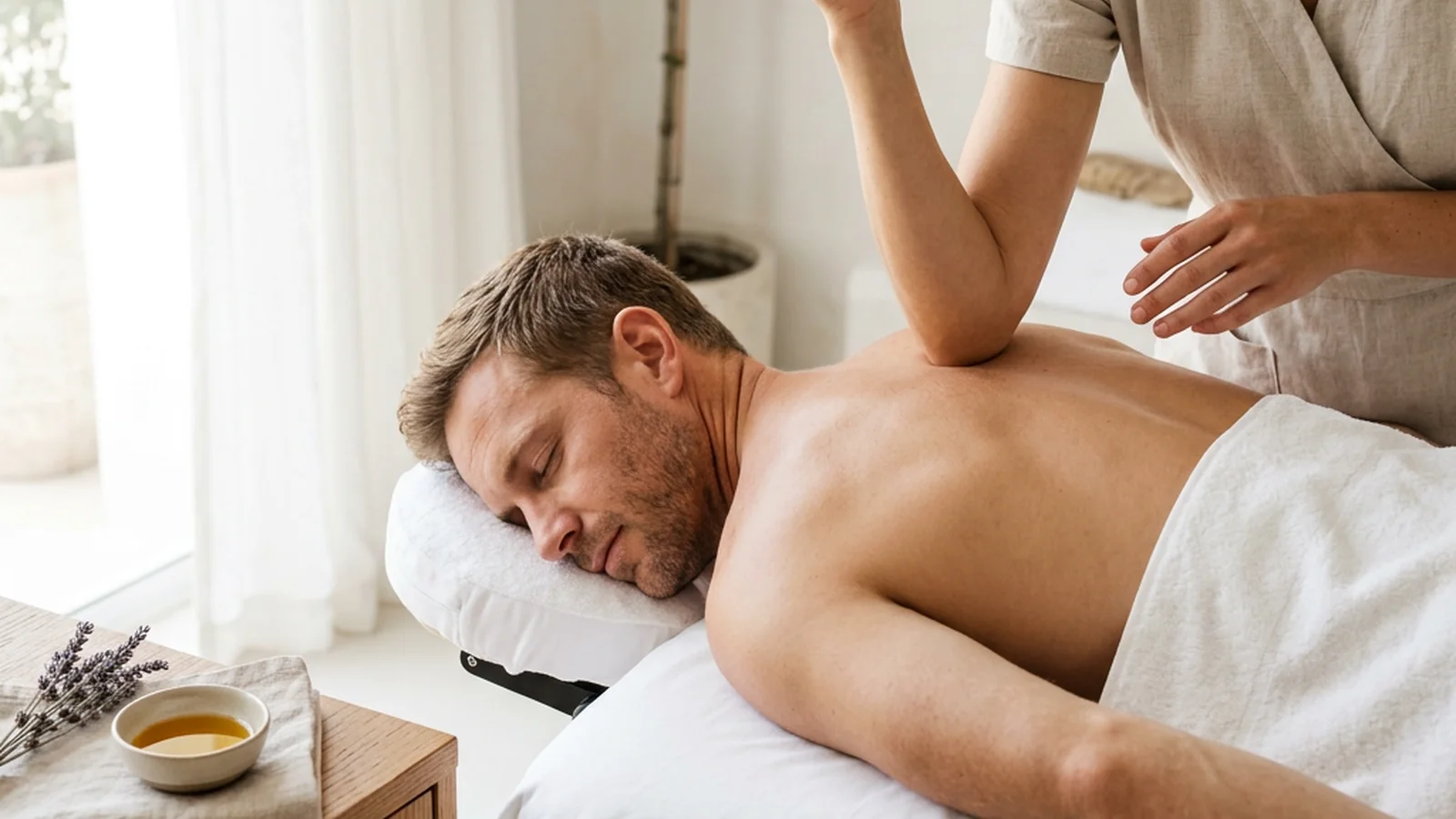
Deep tissue massage is slow, sustained pressure worked into the deeper layers of muscle and the connective tissue around them — not a harder version of a relaxation massage, but a different job done at a different pace. An hour of it at Spring Massage in McKinney costs $70, and 60 minutes is the length most people book when the complaint is a low back. Whether that hour will do anything lasting is a fair question, and the honest answer carries more caveats than most spa pages admit.
A stiff low back is the single most common reason people book their first professional massage, and it is the topic where studio marketing runs furthest ahead of the research. Search for massage for lower back pain and you will find a hundred pages promising release, correction and repair. So this article does the awkward thing: it names the sources, quotes what they actually say, and stops where they stop.
What the firmer style actually is
The technique is defined by pace, not by force. The American Massage Therapy Association describes it as slow strokes and deep, sustained finger or forearm pressure aimed at the deeper layers of muscle and connective tissue. A relaxation massage covers the whole back in a few minutes of long gliding strokes. This work might spend those same few minutes on one side of the sacrum.
Why pace matters more than force
Pressure applied quickly makes a muscle brace against it. Pressure applied slowly gives the tissue time to yield. That is the entire mechanical argument for the style, and it is why a therapist working a tight lumbar area moves at roughly the speed of a second hand rather than the speed of a stroke. It is also why 30 minutes aimed at one region often does more than a scattered hour aimed at everything.
What it feels like along a sore back
Expect a firm, dragging sensation rather than a sharp one, usually along the erector muscles either side of the spine, then across the top of the glutes and out to the hips. Most low backs are not sore in isolation: the hip flexors, glutes and hamstrings are part of the same argument. That is why a 90-minute session at $110 tends to be the one people rebook after starting with 60.
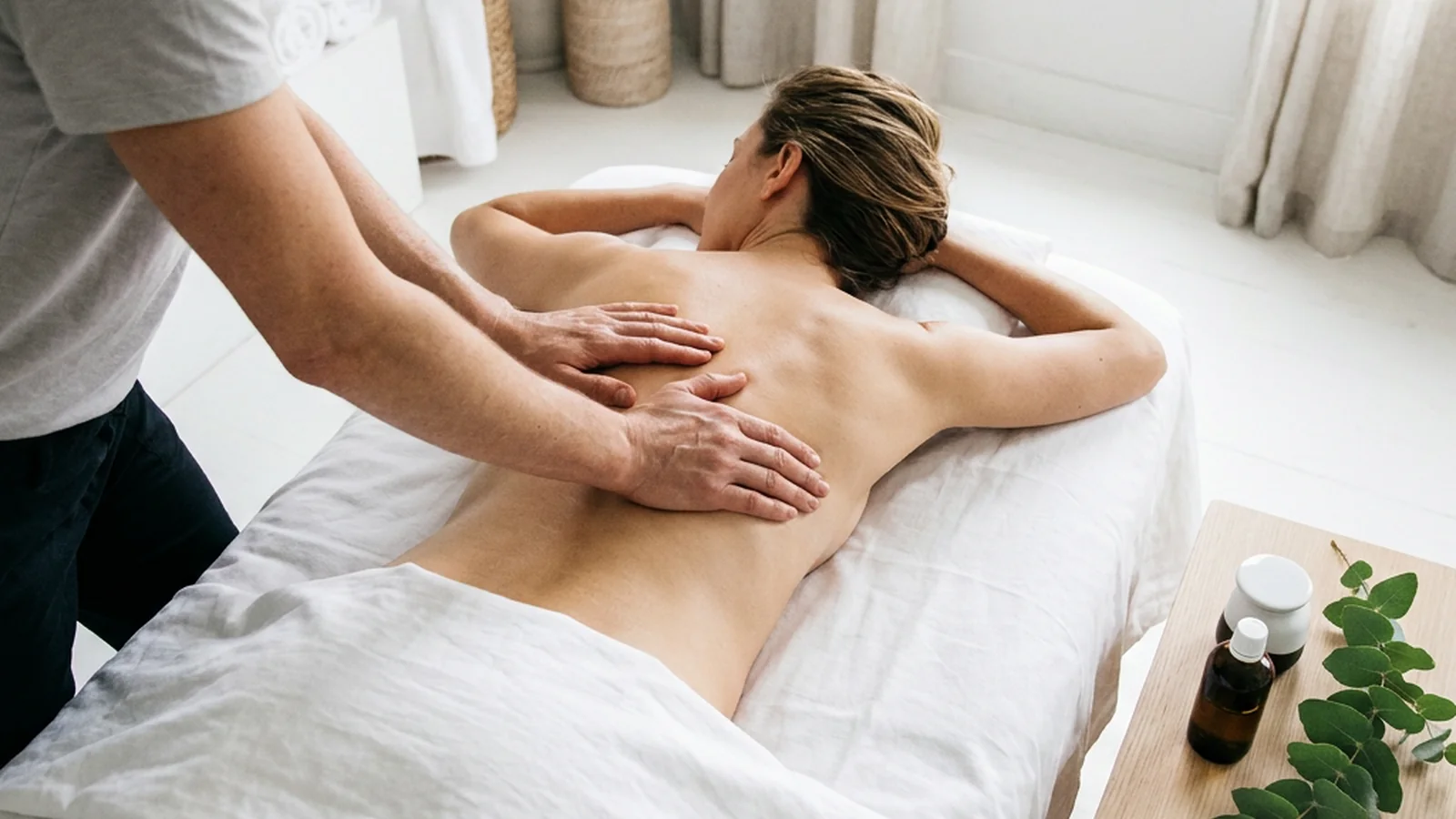
What the evidence says about massage for lower back pain
Start with the division clinicians use, because every finding below depends on it. Back pain is called acute under about four weeks, sub-acute from roughly four to twelve weeks, and chronic at twelve weeks or more. Those three words are doing most of the work in the research, and almost none of the work in spa advertising.
Acute and sub-acute pain: a short-term maybe
The National Center for Complementary and Integrative Health reports that massage may help acute and sub-acute low-back pain in the short term. Read that sentence at its face value: may, and short term. It is a modest, real, useful finding. It is not a claim that an hour on a table changes the structure of anyone's spine.
Chronic pain: where the guideline stops
For pain that has been there twelve weeks or longer, the same NCCIH page notes that the American College of Physicians guideline does not include massage among its recommendations for chronic low-back pain. That is a conspicuous absence, and every honest studio should say so out loud. NCCIH's own clinician digest reviews the wider trial evidence condition by condition and grades most of it low- to moderate-quality, with benefits that are usually short-lived.
Deep tissue work releases the knot and fixes the underlying problem.
No approved source says that. NCCIH puts the effect at short-term relief for acute and sub-acute pain, and the American College of Physicians guideline leaves massage out of its chronic low-back pain recommendations altogether. Reduced tightness that lasts days rather than weeks is the realistic outcome.
The honest summary, in one paragraph
The case for massage for lower back pain is real but narrow. A session can reduce the sensation of tightness, often for a few days, sometimes a little longer. Some people get more; some get a pleasant hour and no change at all. Nothing in the approved evidence supports the idea that massage treats, corrects or cures a back. What it does is buy comfortable time — and comfortable time is when the things that genuinely move the needle, like movement and sleep, become possible again.
“Massage may help acute and sub-acute low-back pain in the short term — and the chronic-pain guideline leaves it out. Both halves of that sentence are true, and both belong on the page.”
When to see a clinician before booking
How to get the most out of a back-focused hour
-
Point at it
Before you get on the table, put one finger on the spot. A therapist given a location works that location; a therapist given "my back hurts" works everything, at a third of the depth. -
Ask for the whole chain
Low backs rarely act alone. Ask for the glutes and hip flexors as well — which is the honest argument for 90 minutes at $110 over 60 minutes at $70. -
Calibrate the pressure out loud
Say "that is right" or "lighter" in the first five minutes. Mayo Clinic's guidance is explicit that massage should not be painful, and the pressure changes the moment you ask. -
Breathe rather than brace
If you are holding your breath, the pressure has passed the useful point. Breathing through firm work is the difference between tissue that yields and tissue that guards. -
Move afterwards, gently
Walk. The session leaves a window in which movement is more comfortable, and movement is the part with better evidence behind it than the table itself.
How long, how firm, how much
Every rate below is published, and it is the rate you pay — no membership, no first-visit price that changes on your second visit. Card payments carry a $2 transaction fee, which the studio publishes rather than hides.
| Session | What it covers | Price |
|---|---|---|
| 30 minutes | One region — the low back on its own | $50 |
| 60 minutes | Low back, hips and the whole of the back | $70 |
| 90 minutes | Back, hips, glutes and legs, unrushed | $110 |
| 120 minutes | Full body with extended time on the back | $140 |
| 60 minutes, lighter | Whole-body relaxation massage instead | $65 |
- What it covers
- One region — the low back on its own
- Price
- $50
- What it covers
- Low back, hips and the whole of the back
- Price
- $70
- What it covers
- Back, hips, glutes and legs, unrushed
- Price
- $110
- What it covers
- Full body with extended time on the back
- Price
- $140
- What it covers
- Whole-body relaxation massage instead
- Price
- $65
- Sore in one place you can point to? Firm pressure, 30 or 60 minutes.
- Whole back braced after a hard week? A relaxation massage may serve you better.
- Back and tired feet together? The body-and-foot combo gives 40 minutes on the table and 20 on the feet for $60.
- Both of you have the same complaint? The couples version is $130 for both guests, on two side-by-side tables.
Booking a session in McKinney
Spring Massage is at 1400 N Coit Rd #102, McKinney, TX 75071 — suite 102 in the Crescent Parc centre, on Coit Road at Prestwick Hollow Drive, one block south of US-380. There is surface parking directly outside the door. That corner sits on the western seam of McKinney, so Prosper is about 10 minutes north, Frisco about 15 minutes south-west, and Stonebridge Ranch about 10 to 12 minutes east. The studio has been open since August 2024, every day, 10 AM to 9:30 PM, and same-day appointments are often available — see same-day and late-evening appointments for how the live availability works.
- Prosper — about 10 minutes north along Coit Road.
- Frisco — about 15 minutes south-west.
- Celina — about 18 minutes; Fairview about 22.
- Allen, Melissa and Little Elm — about 25 minutes each.
- Historic downtown McKinney — about 18 to 20 minutes east.
- Plano — about 35 minutes south. All are off-peak estimates, not measured times.
Sessions run 30, 60, 90 or 120 minutes, from $50. Call (469) 927-8441 if you would rather describe the problem out loud before you pick a length, or book online and choose it yourself — the calendar shows the same-day openings as they stand.
In Texas, massage therapy is regulated by the Texas Department of Licensing and Regulation, which issues the Massage Therapist licence under Chapter 455 of the Texas Occupations Code and also licenses massage establishments. The studio's own booking page describes its therapists as licensed massage therapists, and the TDLR register is public, so any credential can be checked in about a minute.
Deep Tissue Massage
Slow, firm pressure into the layers that actually hurt — for desk shoulders, tight low backs, and training loads that never fully unwind.
- 30 min $50
- 60 min $70
- 90 min $110
- 120 min $140
Prices in USD, published in full — a relaxation massage is $65 for the same hour. Card payments carry a $2 transaction fee.
If you are booking a massage for lower back pain and would rather compare before you commit, the full McKinney price list sets every service side by side, and the deep tissue service page covers what a session on North Coit Road involves. If the tightness sits higher up than the belt line, the companion article on neck and shoulder tension is the better read.